

What is the best carrier for a newborn?
There is no single best choice: it depends on your needs, how much adjustment or wrapping you want to learn, and how you plan to use the carrier.
The woven wrap and ring sling can be used from 3 kg: the first offers excellent support and versatility, while the second is compact and quick for short, frequent carries. Regolo Newborn is the adjustable BabyMonkey carrier suitable from 3.5 kg, designed for those looking for a quick and easy option.
Three ways to start babywearing
Woven wrap
From 3 kg
The most supportive and versatile option. It takes a little practice to learn the wraps, but adapts very well to both baby and wearer.
Ring sling
From 3 kg
Quick to put on, compact and especially practical for short, frequent carries.
Regolo Newborn
From 3.5 kg
The adjustable carrier for those who want a simple, quick option, with a seat and panel that adapt as your child grows.
Newborn positioning in the carrier

Legs in the “M” position
The carrier should support the baby with the knees higher than the bottom and the seat well supported.

Back supported in its natural curve
In the first months, the carrier should support the torso without forcing the baby into an overly rigid or upright position.
Why carry a newborn?
Babywearing can be a practical help in everyday life: closeness, contact and freedom of movement for the wearer, while always paying attention to the baby’s position and safety.
1 - The need for closeness
In the first months, many newborns frequently seek closeness, containment and contact. A wrap or carrier keeps the baby close to the body while giving the wearer more freedom of movement.


2 - Support and freedom of movement
A properly adjusted carrier supports the baby while keeping them close to the wearer. For the parent, this means being able to walk, move around the house or manage situations where a stroller is impractical, without giving up closeness.
3 - Breastfeeding: what to know
Keeping your newborn close can make it easier to notice feeding cues and manage feeds during the day. If you choose to breastfeed while babywearing, do so only when you are confident adjusting the carrier and can continuously monitor your baby’s position, face and airway; once the feed is over, return the baby to the correct carrying position.


4 - Pay attention to temperature
The wearer’s body and the carrier fabric add warmth. It is therefore important not to overdress the baby, to check that they are not too warm, and to adjust clothing layers to the season and environment.
5 - When your newborn is unsettled
Contact, movement and closeness can help some babies relax and settle. Babywearing is not a treatment for colic or persistent crying: if your baby seems distressed or the crying is unusual, speak with your pediatrician.


6 - Time with dad too
Babywearing can also be a simple way for dad or another caregiver to spend close time with the baby: walking, moving around the house and sharing everyday moments while keeping the little one close.
7 - When baby falls asleep in the carrier
Many babies relax with movement and may fall asleep while being carried. Even during sleep, it is essential to make sure the face always remains visible and unobstructed and that the baby stays in a correct, well-supported position.


8 - Versatility in everyday life
Wraps and carriers take up little space and can be used at home, outdoors, while travelling or when a stroller is inconvenient. The carrier and the way it is used change as the child grows and the family’s needs evolve.
“Won’t that spoil the baby?”
Babywearing does not mean keeping the baby in a carrier all the time: it is a tool that can support family life and change over time as the baby’s needs evolve.

Closeness does not mean “spoiling”
In the first months, seeking closeness is normal. Responding to a baby’s need for contact does not stop them from exploring and moving when they are ready.

A carrier does not replace free movement
Babies also need time out of the carrier to move, play and explore their motor skills.

Babywearing changes over time
Positions, duration and frequency of use evolve as the child grows and family routines change.
The adjustable BabyMonkey ergonomic carrier for babywearing from 3.5 kg, with an optimal fit up to approximately 85 cm / 2 years.

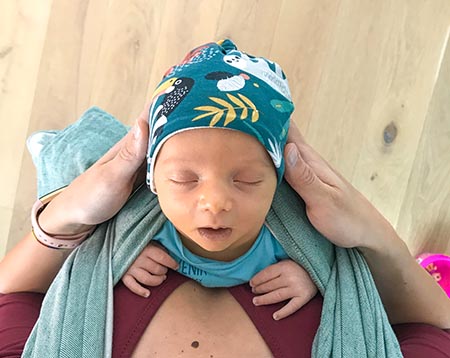
Discover our babywearing wraps and slings, both suitable from 3 kg: a woven wrap for maximum versatility and a ring sling for quick, compact use.
Still not sure which one to choose?
If you have questions about the carrier, fit or how to use it, our team is always happy to help. Tell us your child’s weight, height and age and we’ll help you choose.